
“Gotland was found first by a man named Tjelvar. At that time Gotland was so enchanted that during the days it sunk and during the nights came back up. But this man was the first to bring fire to the island, and after that it never sank again.”1

Thus begins Guta Saga, the medieval tale of Gotland’s mystical heathen origins and eventual conversion to Christianity. Recorded in a manuscript dating to the 14th century in Forngutniska (Old Gutnish, the old language of Gotland) but based on an older tradition from the 13th century, it forms a very short appendix to Guta Lag, the oldest surviving document that records the laws of the Gutes (i.e. Gotlanders). The manuscript doesn’t actually provide a title for Guta Saga, but we can thank Carl Säve, a professor of Nordic languages, for fixing that back in the mid-19th century.

Guta Saga is divided into six sections and the first two are the most interesting.2 After covering Gotland’s mysterious sinking habit, primordial discovery, and mystical reaction to the presence of fire, we are informed that Tjelvar’s son and his wife produce three sons of their own. Tjelvar’s descendants apparently had a ton of libido, and each generation’s procreation-heavy behavior results in Gotland eventually becoming overpopulated. To resolve the matter, 1/3 of all Gutes are then chosen by luck of the draw to be forcibly expelled from the island. The expulsion does not go smoothly. At first the outcasts hole up in Torsburgen (an ancient hillfort on Gotland), but then are chased off. After a series of unfortunate attempts to settle at various places, they end up in southeast Europe.3 So that happens.4 Next, we learn that tons of kings warmonger against Gotland and that the Svea (Swedish) kings are the major culprits because of course they are. Fortunately, the Gutes have Beowulf to go broker a peace deal with them.
Wait?! What?!
Yes, Beowulf. That Beowulf. The most famous Scandinavian warrior of all time in English.
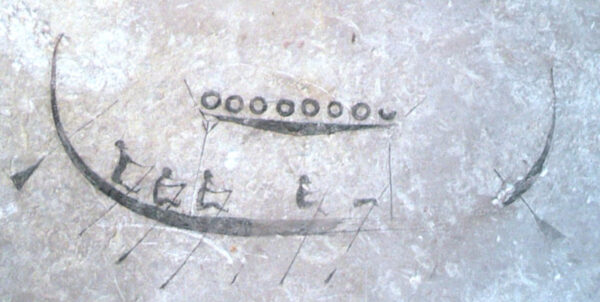
So, Guta Saga includes a passage about Avair Stråben who visits the Svear and arranges a deal wherein the Gutes agree to pay tribute to the Svear in exchange for free passage through all of Svealand.5 The relevance is that Avair Stråben is the guy who Bo Gräslund has hypothesized as being the real-life basis for Beowulf in his treatise Beowulfkvädet: Den nordiska bakgrunden (translated into English by Martin Naylor as The Nordic Beowulf for ARC Humanities Press). The book posits that Beowulf‘s Geats were from Gotland rather than the more commonly accepted Götaland (on the Swedish mainland) and covers a lot of territory before addressing the hypothetical original identity of Beowulf, but that piece of the argument basically rests upon the notion that Beowulf may have been a nickname and that his real name was Ælfhere (or Alvar in the Nordic languages), which is mentioned in the Old English poem. Gräslund’s theories are fascinating, but they aren’t the primary focus of this post. The primary focus of this post is the earlier legendary elements of Guta Saga relating to the hyphothetical Beowulf’s equally hypothetical ancient forebear: Tjelvar! Because Tjelvar’s final resting place exists in reality, in name at least.

A Bronze Age stone ship-setting on Gotland bears Tjelvar’s name. Tjelvar’s Grave is located about one mile from Gotland’s eastern coast opposite of Visby (which lies on the western coast). The ship-setting itself is about 18 meters long and 5 meters wide, and its interior is filled with stones. An excavation in 1930 found that the grave had been plundered at some point in its past. Official specifics about its history and visitor information may be found on Gotland’s länstyrelse website (bara på svenska förstås): Boge Tjelvars grav och Tjälder fornborg.

One of the most interesting tidbits about Tjelvar’s legendary status is that he might be some sort of Gotlandic equivalent to Thor’s servant, Thjalfi, whose name in Swedish is Tjälve. Thjalfi is the boy who recklessly disobeyed Thor’s orders one day by slurping up the marrow from the leg bone of one of the gods’ goats. Anders Andrén (present day professor of archaeology at Stockholm University) and L. Frits Läffler (19th century professor of Swedish language at Uppsala University) have both suggested that the ancient Gotlanders may have considered themselves as descended from a servant of one of the gods rather than from one of the gods themselves (which, honestly, feels somewhat fitting considering that Gotland was eventually dominated one way or another by the Svear, who considered themselves as descended from an actual god).
At any rate, Tjelvar’s Grave is a special place with some very deep folklore surrounding it. Whoever was laid to rest here was obviously important to his society 3000 years ago, and his burial monument endures and impresses to this day.
Lastly, if you want to read Guta Saga for yourself (and lots and lots of commentary), The Viking Society for Northern Research’s edition is available for viewing here. Och om du kan svenska kan du beställa en fysisk kopia av Anders Andréns översättning av Gutasagan från Gotlands Museum här.

- My own translation based on the Swedish translation by Anders Andrén. ↩︎
- Sections 3-6 deal mostly with the conversion and subsequent church proceedings. ↩︎
- This means these exiles may have potential connections to the Ostrogoths, but no one really knows. ↩︎
- Other things happen in sections 1 and 2, too, but I’m providing just a brief overview here, and leaving out the parts about dream premonitions, the dividing of Gotland into three regional territories, and the various blots. ↩︎
- Also, the Svear receive permission to sell grain to the Gutes tax-free, so there’s that. ↩︎
Subscribe to get updates from Scandinavian Aggression!
You know, if you feel like it or whatever. You'll receive a code for 25% off any combination of items at the Puffin Carcass Etsy Store, including signed copies of The Impudent Edda and The Scandinavian Aggressors. Other discounts are included in the newsletter that is sent out to subscribers, which only happens when new nonsense has been posted to the site or whenever there is a discount going on at the Dashery store. Your email is only used for the purpose of sending those updates. It's stored in the secure abyss of WordPress and not shared anywhere or anyhow else. Skål som fan!