
Ymir’s Corpse Interviews is a Scandinavian Aggression initiative in which Rowdy Geirsson picks the metaphorical cloud-matter of authors, artists, and other creators whose works are based on or inspired by the old lore of the North. This time around we have Dan Capp. Dan is the man behind Wolcensmen, a deeply atmospheric, dark, and mythological musical project. Since its founding in southeastern England, Wolcensmen has released two full-length albums to date (Songs from the Fyrgen and Fire in the White Stone) as well as the EP, Songs from the Mere, and the initial, self-titled demo. In addition to his work with Wolcensmen, Dan is also the guitarist/songwriter of Gràb, the current vocalist of Solstice, a former guitarist of Winterfylleth, and was one of the two men behind the recent Garde viking metal album, Harbinger of Revenge and War.
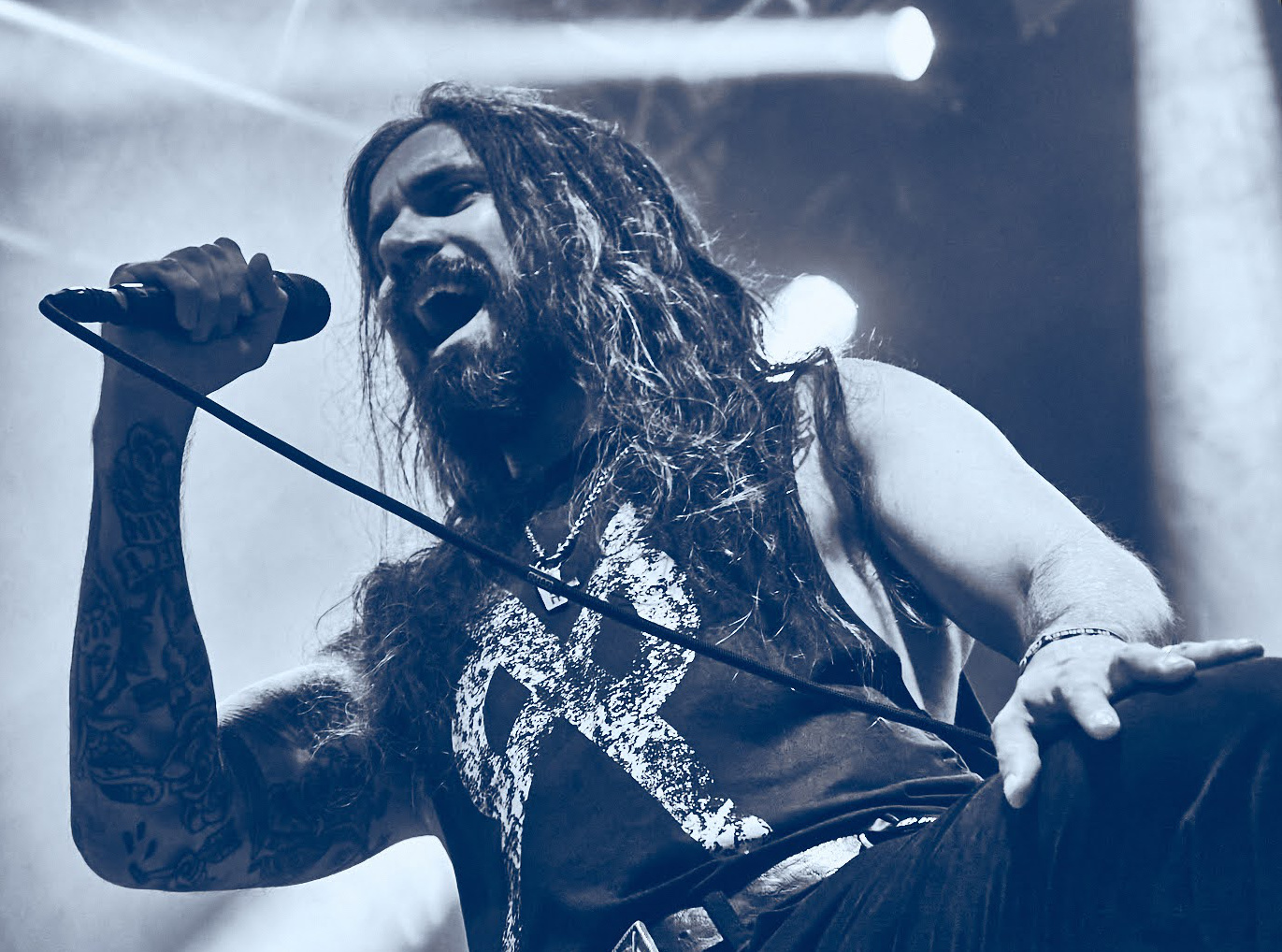
RG: So Dan, welcome! I’m delighted to have a chance to chat with you a bit about your work with Wolcensmen as well as your other creative efforts. But we’ll start with Wolcensmen, the music of which I’ve been listening to and thoroughly enjoying since first finding out about it a few years ago. One of the things that strikes me is how atmospheric the music is in a way that specifically brings to the listener’s mind to the pre-Christian Anglo-Saxon world. I always feel like I have Raedwald and his forebears watching over me from their seats in the hall up high when listening to Wolcensmen. So while related, Wolcensmen’s focus is therefore different from that of musicians focused on the pre-Christian Scandinavian world, which I think we see more often. Where did the desire and idea for this specifically Anglo-Saxon focus come from?
DC: Thank you, Rowdy. I’m honoured that you’ve connected so strongly with my music. In answer to your opening question, beyond the obvious explanation for an Anglo-Saxon focus—my English heritage—there was a spark of inspiration which came in 2010 from being in a Dublin pub whilst tour-managing some friends’ band. There I was in this lively establishment watching an Irish folk band play, and it dawned on me that you almost never see that in England; an English folk band playing in a pub, conveying the English folk tradition to patrons. So I have to say I was inspired by the strength of the Irish tradition, and whilst my music with Wolcensmen doesn’t tend to be as traditional or jolly as Irish folk music is, it is nevertheless an attempt to restore something to England.
RG: That’s interesting you say that live music in Dublin was an impetus. I’ve been to Dublin once and recall thinking how neat it was that so many pubs feature musicians playing in the late afternoons and evenings, and it was generally always traditional songs, as you mention. So one thing I’m wondering is how or why, upon finding this inspiration, did you decide to take Wolcensmen in a dark-folk sort of direction rather than a more traditional folk direction like you heard in Ireland? I’m thinking that there must have been a fork in the road there.
DC: I was just doing what came natural to me. The other side of the ‘Wolcensmen origin story’ is the inspiration I took from black and death metal bands of the 1990’s who dabbled in acoustic or neo-classical composition; bands like Ulver with their fully acoustic album, Kveldssanger, or Opeth who would incorporate lengthy acoustic parts in their songs. Those were really the first musical inspiration for Wolcensmen, even if the impetus to actually do it was in reaction to the Celtic folk scene. It was the dark moodiness of those early inspirations which set the darker tone for Wolcensmen. I’ve never been particularly moved by overly ‘happy’ music, though it has its place in social settings.
RG: And Irish pubs certainly are that. While I enjoy a lively rendition of ‘Galway Girl’ or ‘Tell Me Ma,’ I agree that such songs don’t carry the weight or emotional impact of the type of music you’re describing and creating yourself. I’ve also noticed that you use ‘Anglish’ for at least some of the lyrics, which seems like an intentional strategy to harken back to England’s bygone, pagan Anglo-Saxon era—though you should, of course, correct me if I’ve got anything about that wrong. What is the process like using that vocabulary?
DC: Yes. ‘Anglish’ is a confinement of modern English words which have an Old English origin. In effect, that means it precludes words of French, Latin, or other non-Germanic origin. I have limited my lyrics to the Anglish vocabulary since the first album, Songs from the Fyrgen. It may be interesting if I mention that I hadn’t decided to do this until after the three-song 2013 demo, so when I re-recorded one of the demo songs, ‘Hooves Upon the Shimmering Path,’ I had to alter the lyrics.
Some may suspect an anti-French intention in my decision to use Anglish, but it was never about that, at least not directly. The reader will notice that I use plenty of non-Anglish words in answering these questions. Wolcensmen has always been a vehicle to carry the listener to pre-Industrial England, and Anglish helped me to fuel that vehicle adequately, evoking an archaic atmosphere. It was also appealing to me to explore what an English music or poetry might sound like had England never been conquered by the Normans. That said, I’m not sure that I’ll be so strict about adhering to Anglish on my next record.
RG: I suppose it remains for you to feel out, if it’s appropriate to say it that way. But having broached the subject of language, that, of course, leads into a question about Wolcensmen’s name. In an attempt to do my homework before starting this interview, I read a little about your explanation of the origins of the name in a couple of prior interviews—that the name is Old English for ‘Heavens’ Men’—and so rather than ask you to rehash that, I was wondering if you could explain a bit more about why you chose that specific name? I’m guessing there is some significance in the choice of the word that means ‘heavens.’
DC: I do thank you for not asking me that same question which I have answered so many times before in depth. You may be the first to ask me why I opted for a name meaning ‘men of the heavens.’ Initially, the idea came from a play-on-words (and I love to play on words). It struck me one day that I could combine the Middle English word ‘welkin’ with ‘kinsmen’ – Welkinsmen. But as the themes of the project took shape, I decided that the older, Old English version of the word, ‘wolcen’ would be more appropriate. It meant that I lost the ‘kinsmen’ aspect of the name, but I did gain the Cen (Kenaz) rune in its place. This then inspired the bindrune logo that came to be, which we can discuss later.
‘Men of the heavens’ seemed fitting because the one vision which has never wavered is of Wolcensmen being spiritual music. As spiritually-charged as possible, really. If someone describes my music as a spiritual or religious experience, then that’s the biggest compliment I could receive. I wanted the music and lyrics to be above the mundane, and so ‘men of the heavens’ seemed like a good name for that type of band…and yes, it was originally intended to be a band consisting of multiple musicians. On the studio recordings and early live performances, it is, but I was never able to find a set of permanent members who shared quite the same vision as I. ‘Wolcensmen’ is a subtle, quirky misnomer, I suppose.
RG: And as I understand it, the spiritual nature behind Wolcensmen’s music is not just an aesthetic, but is fully embodied in the music. When did you first become interested pagan spirituality and what concepts/values do you find yourself celebrating or honoring most often in the music?
DC: Yes, indeed. As mentioned, Wolcensmen was always intended to be spiritual music, and not because I thought that’s what might sell well or give me some kind of commercial edge. It is because I am a spiritual man and the deeper concerns and philosophies of existence matter to me a lot.
I was interested in the ‘paranormal’ from a young age, though I wouldn’t say I’ve ever been someone particularly sensitive to paranormal activity. I was strongly drawn to the stories and aesthetics of paganism as introduced to me by Norwegian Black Metal in the late 1990s. The actual belief probably came as the result of four books by two authors—all of which I read around the turn of the millennium: Fingerprints of the Gods by Graham Hancock, which introduced me to the possibility of a spiritually advanced, antediluvian civilisation; Supernatural by Graham Hancock, which introduced me to the ‘science’ of spirit entities, gods, and otherworldly beings; The Real Middle-Earth by Brian Bates, which introduced me to a deeply superstitious pagan England of old; and The Way of Wyrd by Brian Bates, which really brought that world to life in vivid colour and gave me a sense of how it would be to live in a pagan land.
I suppose the values that I most often write lyrics about and try to convey the emotion of in my music are those of conviction, courage, and sacrifice. Many of my songs are about a quest of one sort or another, where one discovers something profound about the world or about themselves. To psychoanalyze myself for a moment, this could be because I find the lack of valour in modernity galling. Nowadays, every action or decision is reduced to pragmatic utilitarianism, where it is deemed futile for lack of material benefit (to oneself). Read old literature, even as recent as Lord of the Rings, and you can still find depictions of a mankind which holds to nobler values and an insistence upon the preservation of beauty and goodness, whatever the cost.
RG: That’s well said, and I think a lot of us feel what you mean about these nobler values. But I want to circle back a little to the books you mentioned as they definitely bring new thoughts to mind. I’ve actually read Hancock’s Fingerprints of the Gods, though it was very long ago, but I nonetheless found it fascinating. I’ve never read Bates’ books, though I probably should—the to-be-read pile is always never-ending—and the first I heard of them was in 2023. I had attended Månegarm Open Air with a friend of mine, Matt Smith, and we had returned from the festival and were roaming around Stockholm when the conversation turned towards Bates’ work, which Matt was familiar with. And then the conversation turned towards Sabbat’s Dreamweaver, which I’ve since become familiar with. So I’m now, of course, curious if that album has served as any sort of inspiration or offered up some significance in your evolution as a musician and artist whether in regards to Wolcensmen or any of your other projects?
DC: I wasn’t aware of Sabbat’s Dreamweaver until after I’d read Bates’ book, but when I found out there was a metal album based upon The Way of Wyrd, I was immediately interested. And I have to say, whilst not usually being a big fan of thrash metal, I did fall in love with that album and consider it one of my favourite thrash albums to this day. The lyrical poetry helps, but there’s also something about the music and production; the ultra-precise, rhythmic staccato delivery of vocalist, Martin Walkyier, and the aggressive, brutish guitar tone of Andy Sneap (who nowadays plays in Judas Priest). Those are two ingredients I’m attracted to in extreme metal, and so, of course, I like to achieve it with my own projects, such as Gràb. I am a real stickler for vocal timing, always trying to improve my own. I would say that in Solstice, although I don’t primarily write the lyrics, the overtly English feel of the poetry has been inspired by Sabbat. I think Solstice lyricist, Rich Walker, would confirm that.
RG: So in addition to the clear inspiration related to these modern studies and artistic works, are there any Anglo-Saxon texts, sites, legends, etc. that you find yourself likewise turning to for inspiration? Do you ever look to the Scandinavian or Continental Germanic sources as well?
DC: My answers here may be somewhat controversial. I’m not that well-read in terms of Indo-European source material. I’ve read the Poetic and Prose Eddas several times, but I’ve only read a handful of Icelandic sagas and other texts, and Beowulf just once many years ago. Perhaps the early texts I return to most often are Hávamál and the rune poems.
Tolkien’s work is a huge inspiration and, to be even more controversial, I sense a profound, eternal truth in that work that rivals even that of older religious texts and folk mythologies. Whether that’s because Tolkien had an intimate knowledge of those source texts and mythologies, and was able to draw from them the core wisdoms, or whether for other reasons (there is actually a fringe school of belief that Tolkien had access to ancient texts which have been kept otherwise secret). I’m a big proponent of ‘trusting one’s gut instinct’, and when I read (and re-read) Tolkien, my gut tells me I’m reading something mythologically or even cosmogonically profound.
I am a proponent of the comparative study of mythology also, so I have a broad list of folklore texts to read; some such as Kalevala and Mabinogion which I’ve yet to read. Others such as the Tales of the Narts, Parsifal, and The Epic of Gilgamesh which I have read. My focus tends to be on the Germanic/Scandinavian, as that’s my heritage, but I’m pulled in numerous directions, gladly.
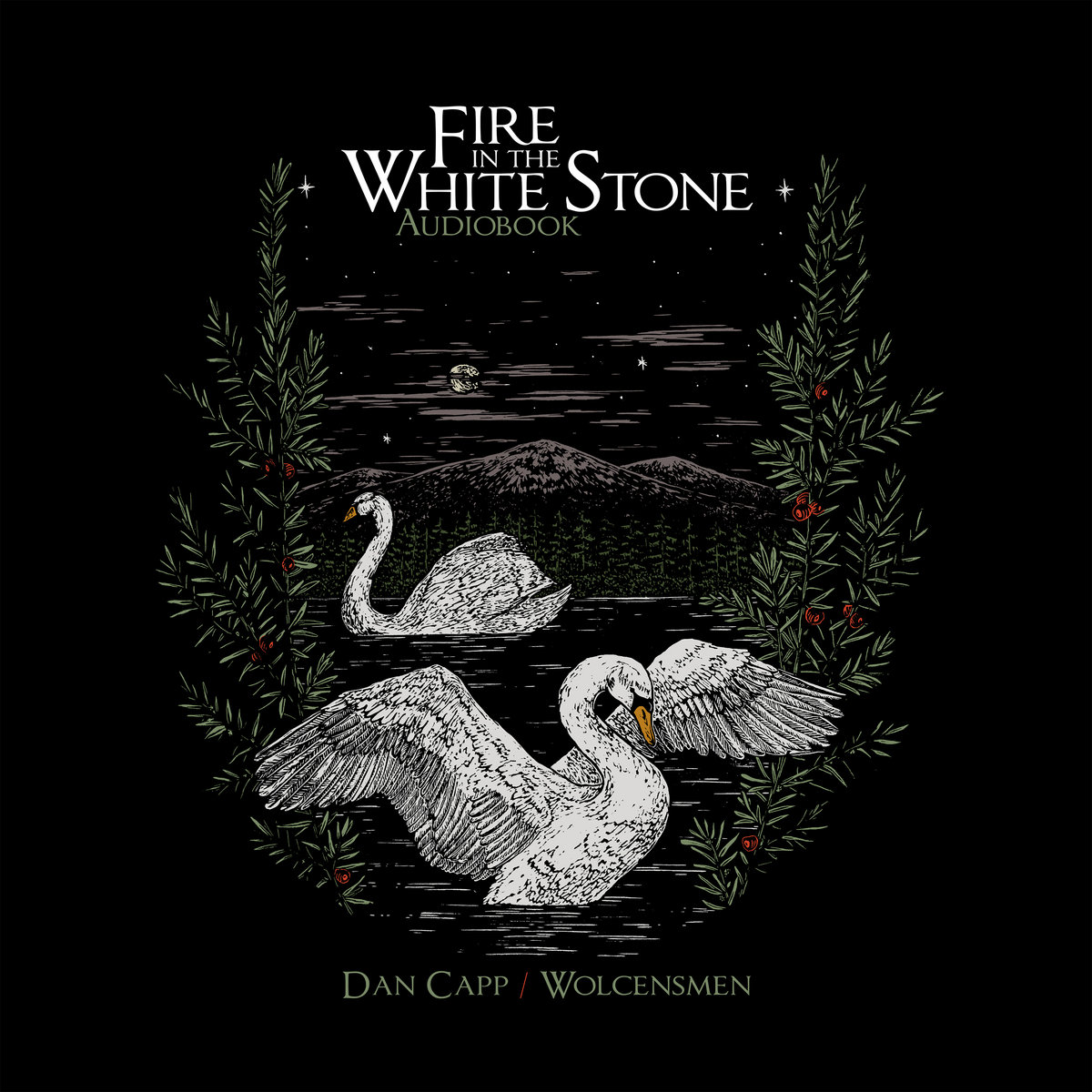
RG: And whether truly ancient like The Epic of Gilgamesh or more modern but with a clear eye to the visions and values of the past like Tolkien’s works, these are all works that feature a distinct element of narrative and story-telling. And I think that leads in well to this next question. I know that Fire in the White Stone is not just a music album, but also a short story and audiobook, as well, which is really cool. So this is an extended original narrative pairing with the original concept album that draws on the mythology and folklore of the ancient Anglo-Saxon world. Where did the idea come from to write a story to accompany the album and what was the process like in creating them both?
DC: Well, as Wolcensmen was intended as a vehicle for timeless spiritual ideas (which traditionally come to us through mythology), it seemed natural to engage in a mythopoesis of my own. Over the years, I had gathered a bunch of theories and ideas which I wanted to express to the world somehow. Some of those ideas were what is often called ‘UPG’ (unverified personal gnosis) and some of them were in accordance with known ideas and traditions.
Also, I find it easier to compose lyrics when I have a framework to set them against. Plucking lyrical ideas out of thin air is more challenging to me than being restricted by an overarching concept such as a story. At the time of making Fire in the White Stone I wanted to try my hand at ‘scoring’ a narrative, like the soundtrack to an unfilmed story. I’m pleased with what I achieved.
The story I created is primarily inspired by what are often called ‘the Grail Runes’; the runes exclusive to the Anglo-Frisian Futhorc which seem to represent the hallowed objects of Arthurian Lore: sword, spear, cup, and stone. I was strongly inspired to build a story around that, as well as the ALU runic formula which I have been developing a relationship with for some years. But I must mention that my story does not draw solely from the Anglo-Saxon world, but from wider, perennial Indo-European ideas.
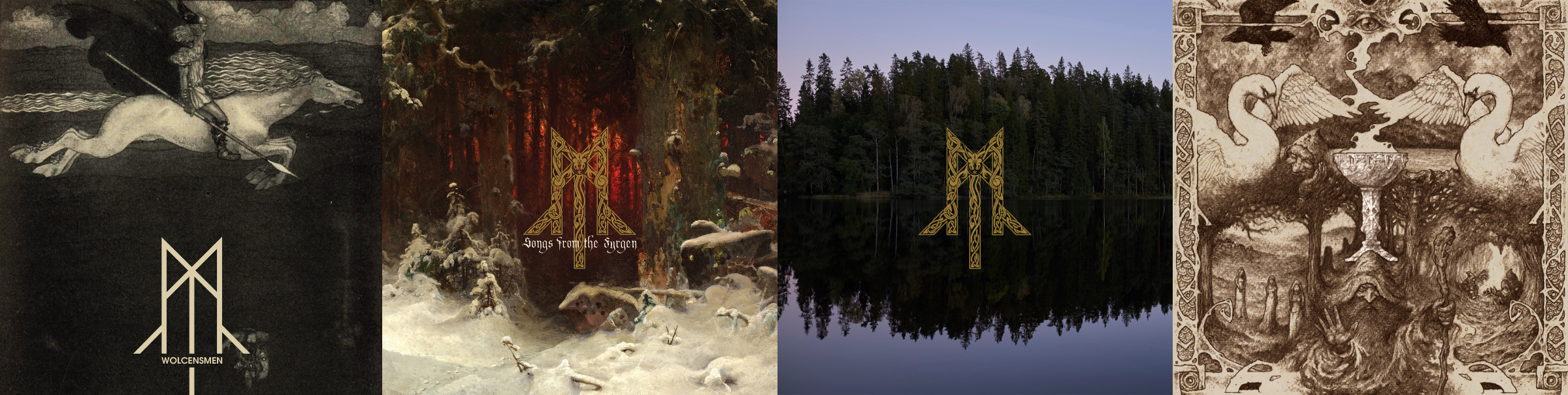
RG: I have to admit my runic knowledge is quite lacking for someone who otherwise spends an inordinate amount of time reading and studying up on this general sort of subject matter. This is the first I’ve heard of runes specifically potentially related to Arthurian lore, so I thank you in advance for the rabbit hole I’m going to go down on that in the near future. But since we’re now discussing runes, this would be the perfect time to ask if you can explain the meaning of the Wolcensmen runic logo and how it evolved? I noticed it went from consisting of simple, thick, solid linework to a more elaborate and artful version containing serpentine patterns within thinner outer edges. And did you handle all the design yourself?
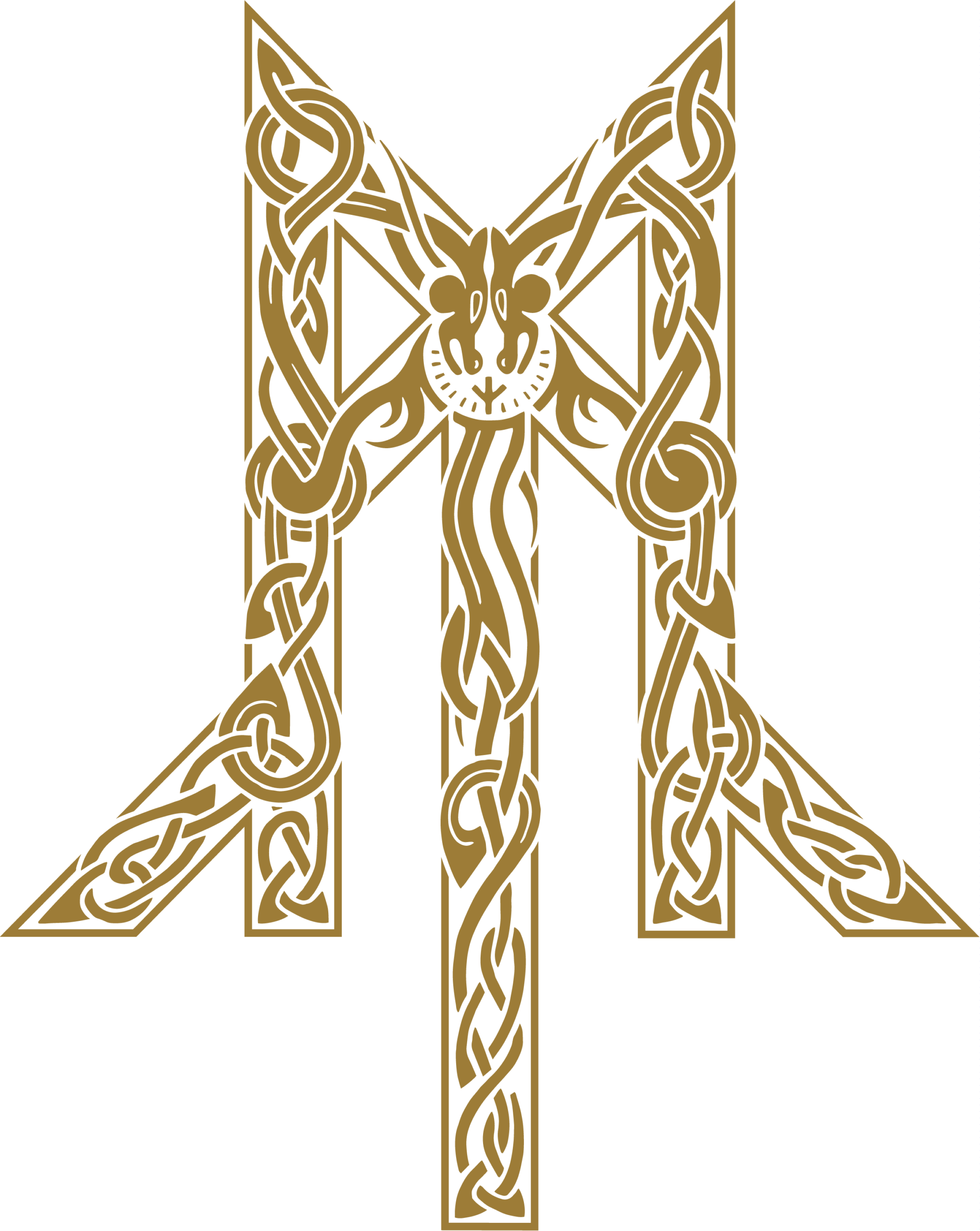
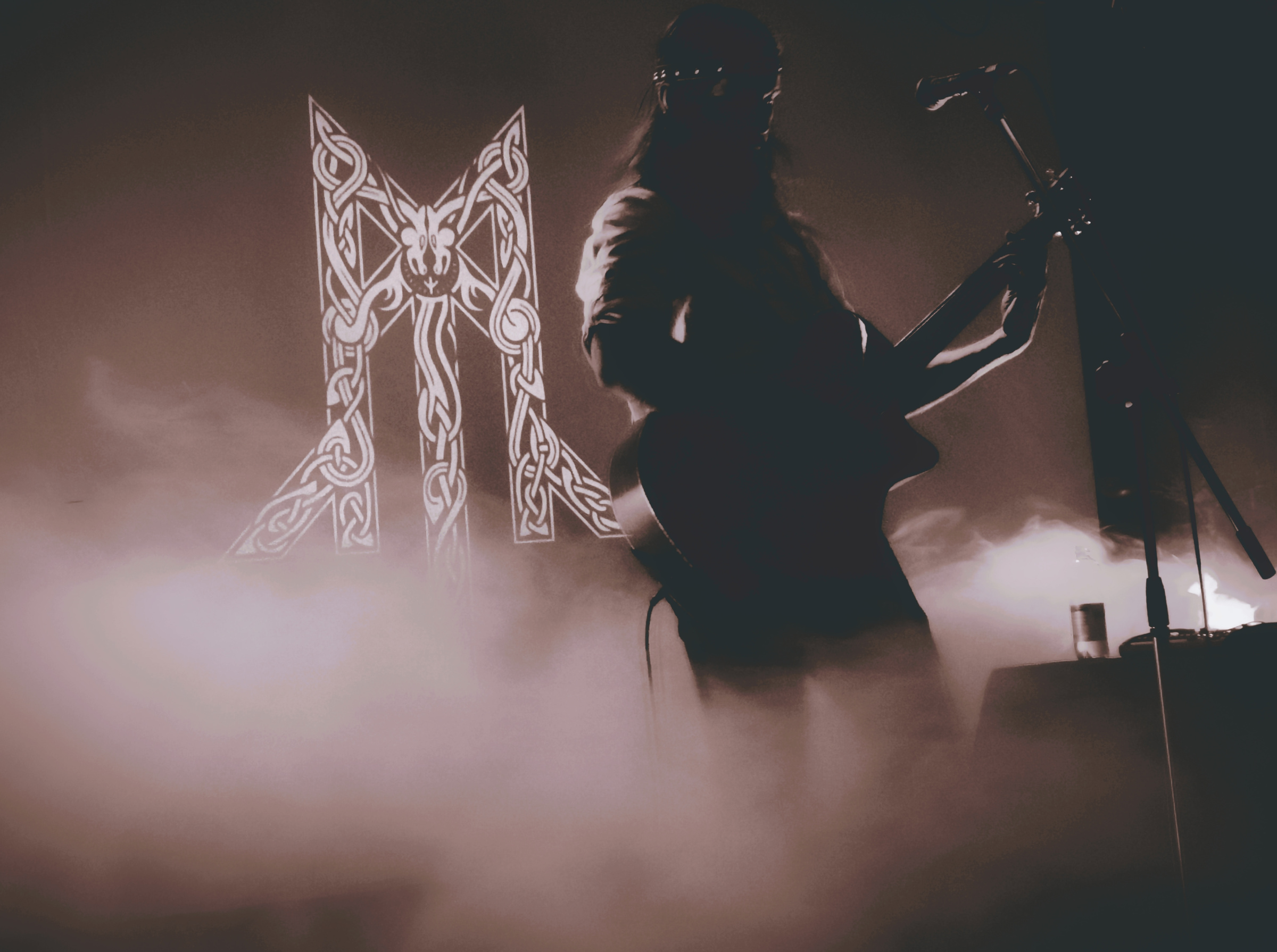
DC: Yes, I am a graphic designer by trade, so most Wolcensmen art is handled by me. Early on, I wanted an emblem to represent Wolcensmen, partly because I don’t think the name itself is instantly memorable. It seemed that I should take runes that are linked to the name and form a bindrune from them: ‘Tiw’ (Tiwaz) to represent the skies/heavens message of ‘wolcen’; ‘Man’ (Mannaz) to represent the ‘men’ part; and ‘Cen’ (Kenaz) for the ‘-cen’ part. The Cen rune holds the power of kinship as well as wisdom and venturing into unknown or unfamiliar territory, which is an important principle in this project.
When I decided to make a full-length album, I quickly found the artwork that would perfectly suit the atmosphere of the music (Skoginteriør by Ludvig Munthe), and had the idea to overlay the Wolcensmen bindrune right in the centre of that piece, but I wanted it to be grander and more decorative than the simple, lined bindrune I used on the demo. The ornate bindrune has since become a vital part of my aesthetic.
RG: I certainly think it is very effective and iconic, too. Plus, I always appreciate when there is a meaning behind a symbol or image or just general work of art. Even if I don’t always know what it is offhand myself—sometimes it’s apparent there is a deeper meaning; I knew that to be the case with the logo. So thank you for providing that explanation. And since you mentioned you are a graphic designer by trade, how did you get into that field and are there any favorite or memorable projects you’ve worked on that you’d like tell us a little about (involving Wolcensmen or otherwise)?
DC: Yeah, I studied graphic design at university, back in 1999-2002 and had a couple of jobs until 2014 when I became freelance and have been ever since. From 2010-2014 I worked for Plastic Head Distribution, who owned the legendary black/death metal label Candlelight Records at the time. Because of my time there, I came to work on several Burzum records, countless vinyl and CD reissues for bands such as Emperor and Opeth, and loads of merchandise designs. My biggest ‘claim to fame’ in that realm would probably be the hand-drawn art for the Burzum re-recordings album. I then somehow became the go-to guy for band logos for the Salt Lake City metal scene, which spread with requests from elsewhere. I haven’t designed many band logos recently but I went through a period of several years where it seemed to be all that I did.
My graphic design work opened a few doors for me musically. For example, my band Gràb was originally a design client of mine. Matthias the band leader and I hit if off during the design phase of the first album Zeitlang, and then after hearing my compositions, Matthias asked me to join Gràb as songwriter.
RG: You’ve clearly been very busy on all fronts. I was vaguely aware you worked in graphic design prior to starting this discussion, but had no idea how extensively. What are some of the band logos you designed if you don’t mind my asking?
DC: I guess the most well-known would be Spirit Adrift, Caladan Brood, Visigoth, Eternal Champion, Thangorodrim, Out of Season Records, and Wolcensmen of course, though I must have done at least 100 band and label logos by now.
RG: That’s pretty cool; I would imagine it is both fun and humbling whenever you come across one of these logos you created, whether on an album, shirt, or stage backdrop. I have some decent metal knowledge but would never refer to myself as an expert. That said, I do know the Visigoth logo, so it’s fun to learn where that came from now. To keep on the metal theme and veer into blatantly viking-oriented territory, which is a good or bad habit of mine depending on how one wishes to look at it, I know you also recently joined forces with Arjan Peeks of Cultus and Heervader, among other bands, to form Garde and bring the album, Harbinger of Revenge and War, to life. And as I understand it, Bathory was and presumably still is a big influence for you, which certainly comes through in the Garde album. So what was it like creating an overtly viking metal album that does such an homage to Quorthon himself? And do you think there’ll be another?
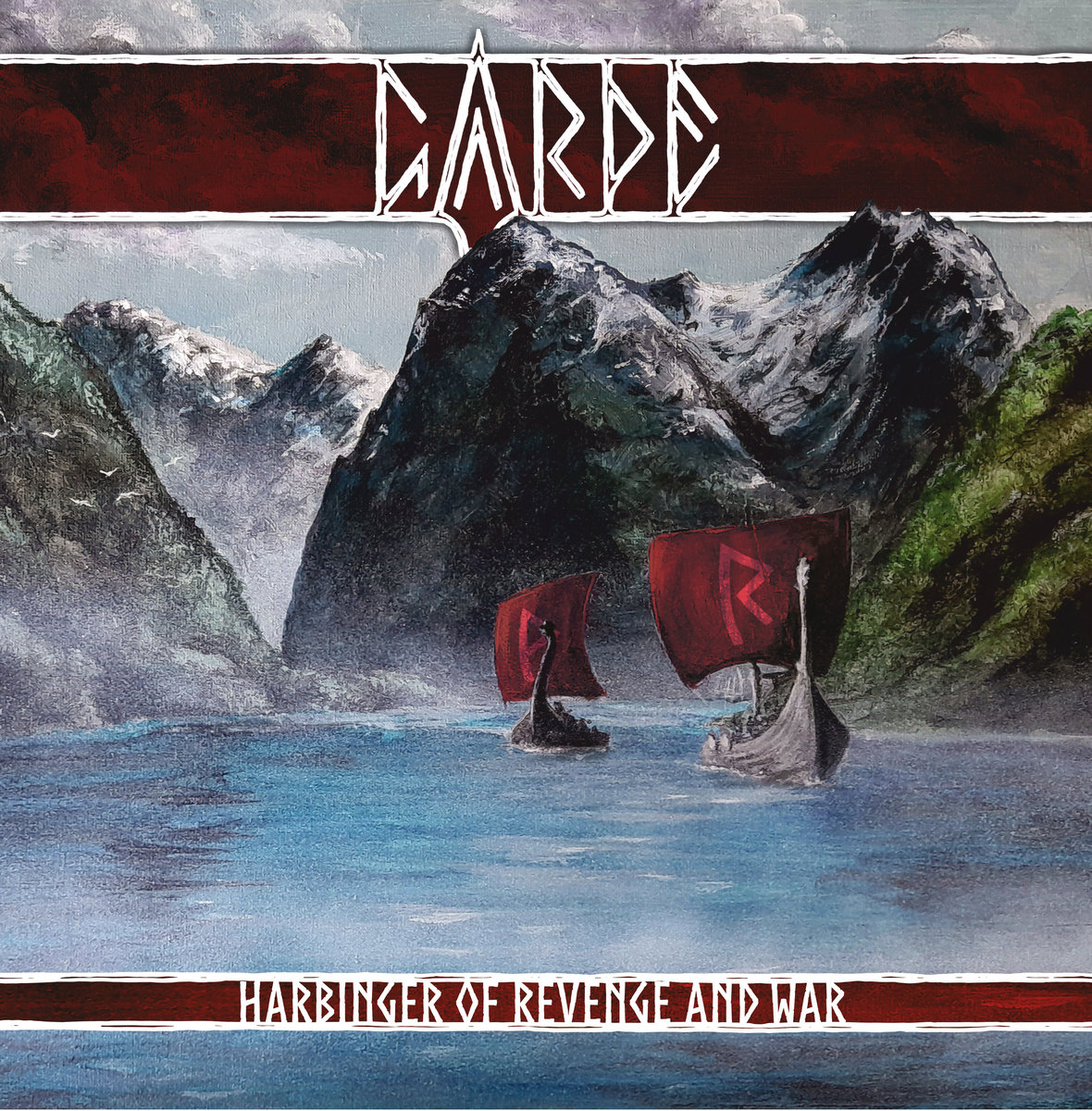
DC: It was great fun making Harbinger of Revenge and War. I’ve known Arjan for over ten years, and he’s been consistently supportive of my music (and I of his). A couple of years ago he contacted me to say he’d had these instrumental songs sitting around for over twenty years and needed someone to add vocals. I’ve come to love singing, so I leapt at the opportunity. Arjan had written the lyrics so I was able to step in for the really fun stage of creating vocal lines, melodies, and choirs. I think we’d both love to make another Garde album.
RG: Hopefully it won’t take twenty years for the follow-up! I know you’ve been very busy over the years in other bands, too, such as Gràb, Solstice, and Winterfylleth. And I realize I’m not naming them all here and that the precise constellation of which ones you’re active in has shifted with the progression of time, but how have you found the balancing act to be between being an active member in those other bands with the work that goes into Wolcensmen?
DC: I’ve never found that difficult. Wolcensmen fits around my other band duties; not because it has lesser priority, but because it doesn’t need to respect other members’ schedules. When I wrote with Winterfylleth, or with Solstice nowadays, my contributions occur mostly whilst I’m in a room with the other guys; sometimes not, but mostly. Conversely, Wolcensmen music and lyrics occurs when I’m alone, out walking, lying in bed, driving.
In terms of the non-creative aspects of being in bands, none of my bands or projects have ever been that demanding. I play live rarely as Wolcensmen (though I hope to change that), so it has never clashed with the touring/festival commitments of Winterfylleth, Solstice, or Gràb. In fact, there have been occasions where I’ve performed as both Wolcensmen and with one of the other bands at the same festival. It makes sense, especially for a promoter who only has to pay my travel/accommodation costs once and gets two performances out of me.
RG: Two birds with one stone so to speak; certainly makes sense. And now that we’re on to Wolcensmen again, I have seen in your journal entries on the Wolcensmen website that new songs are in the works and that you anticipate releasing a new album in the early part of next year. Is there anything you can share about it at this time?
DC: I’m glad you’ve been following the journal. People tell me they’re enjoying the insight into the long creative process of composing and making an album. The writing stage is nearly complete and I hope to be recording in August (2026) and mixing/finalising in September. I hope to release the album in the early part of 2027, but I will not rush it. I feel I have something to prove with this third album, and I’m confident that if I execute the remaining stages well, then that something will be firmly proven.
What can I share? Well, I am toying with the idea of a Yule song. Fans always tell me that for them, Wolcensmen is Yuletide music, so why not lean into that? Wouldn’t it be nice if we pagans had our own ‘Christmas song’? That said, I don’t want to make promises. Maybe that won’t happen on this album but some other time in the future. Other than that, I feel more creative freedom on this current project than ever before, because I set out to create the ultimate in dark, foresty folk music, and I feel I’ve already done that to the best of my ability. So this next album isn’t trying to repeat that, and will have some totally fresh ideas and textures—some that may even surprise existing fans.
RG: Well, I think we’re all going to only have an increased level of curiosity now after learning that. I’m looking forward to what you reveal on this new one when the time comes. In the meantime, are there any upcoming live performances in the works for Wolcensmen? What was the recent experience in Finland like?
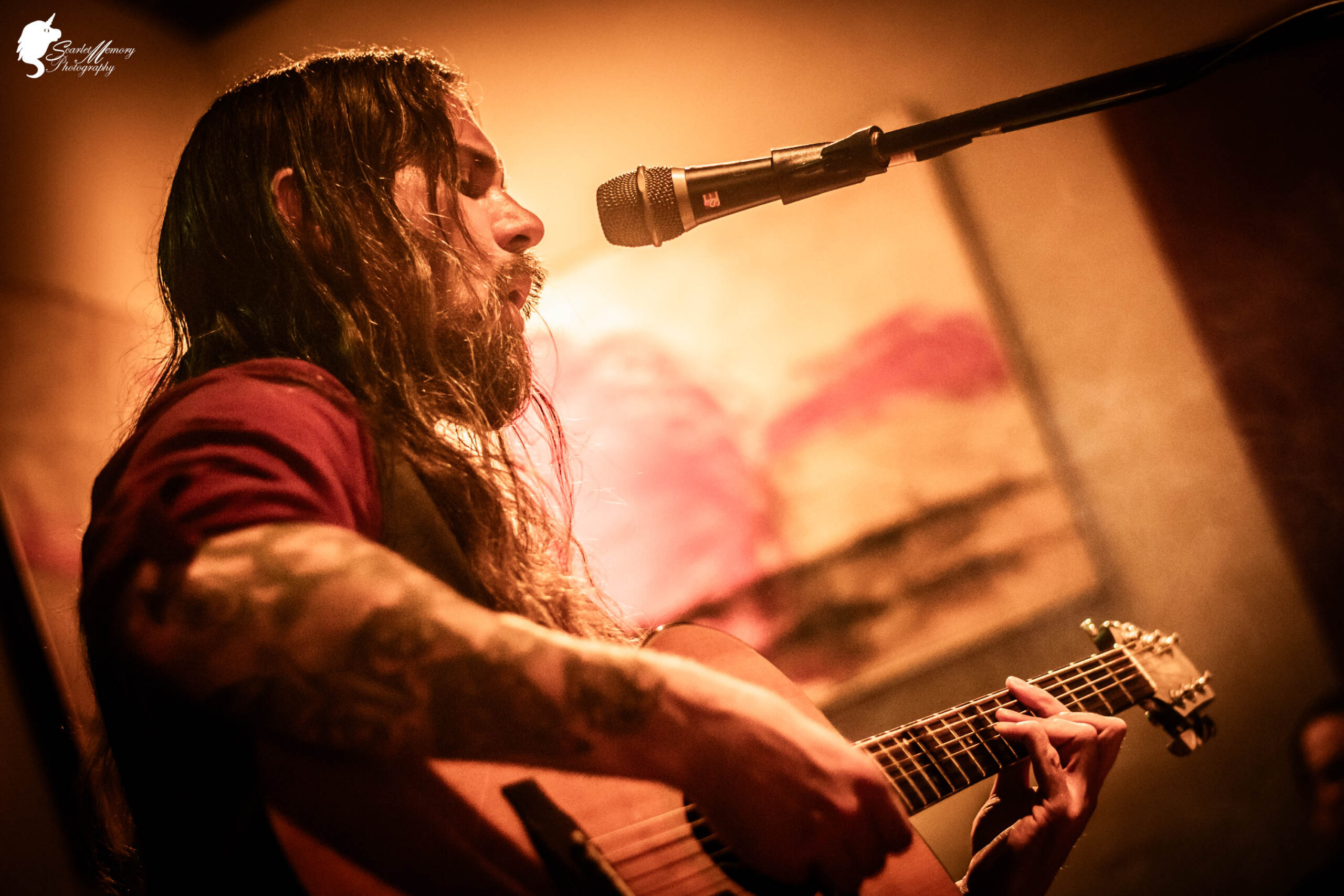
DC: Finland was and is magical. I love it there and seem to be building a loyal following, which I’m grateful for. Certain Finns have gone out of their way to clear a path for me there, and for my other band Solstice who toured there in 2024 also. I have one upcoming booking at Call of the Crow festival 2026 in North Yorkshire, England, which I’m glad to be part of. Other than that, there’s nothing on the cards. I need to focus on the new album, and once that is ready, I’ll be speaking with booking agents and festivals to get some stuff lined up for next year.
RG: Well, if you manage to make it to my neck of the woods in Vinland, I’ll certainly make an effort to come out for the show. Or Sweden, where I tend to spend some time annually, and is probably a more likely candidate. Anyway, one last question just for fun. If you could witness any event, experience any aspect of daily life, or visit any site in pre-Christian Anglo-Saxon England during its heyday, what would it be and why?
DC: Only in pre-Christian England? Yeavering in Northumberland comes to mind, where there is known to have been a heathen temple and site of worship. It would be quite something to witness the proceedings during one of the holytides there. If I were not limited to the Anglo-Saxon period, I’d really love to have spent some time on Salisbury Plain, where sites such as Stonehenge are situated, and near to the Avebury stone circle and countless other monuments. I’ve heard it theorised that that whole area could have been the foundation of agriculture (and thus civilisation) in Britain, and I suspect it was buzzing with life, culture, ritual and magic for a long period of time.
RG: Solid answers, not that there would have been any wrong ones, of course. And I’m glad you offered up an idea beyond Anglo-Saxon England; I just perhaps got a bit hyper-focused on that era due to the Wolcensmen point of entry. The mystery of what exactly people we doing at and around those stone circles is enduring and to get a glimpse would be nothing short of astounding. Anyway, I suppose it’s time to wrap this all up. Thanks so much for taking the time to indulge my questions and curiosity, and I look forward to listening to the new Wolcensmen album when it’s ready, finding out the touring schedule, and whatever else may be unveiled in the coming months!
DC: You’re welcome, and thanks for showing an interest in my art. We live in a time where people’s interactions and curiosities are rather superficial. When I was a young music fanatic, I would pore over every lyric and interview of the bands I discovered (not to mention listening to one album exclusively for weeks on end), but I don’t think that’s common anymore. It’s flattering when someone takes the time to ask in-depth questions and to make the discussion available to those seeking.
Dear Web Prowler, since you’re here, please check out Wolcensmen’s music and give the band a follow on social media via the links below:
Unless otherwise noted, all images associated with this interview are © Dan Capp
Subscribe to get updates from Scandinavian Aggression!
You know, if you feel like it or whatever. You'll receive a code for 25% off any combination of items at the Puffin Carcass Etsy Store, including signed copies of The Impudent Edda and The Scandinavian Aggressors. Other discounts are included in the newsletter that is sent out to subscribers, which only happens when new nonsense has been posted to the site or whenever there is a discount going on at the Dashery store. Your email is only used for the purpose of sending those updates. It's stored in the secure abyss of WordPress and not shared anywhere or anyhow else. Skål som fan!